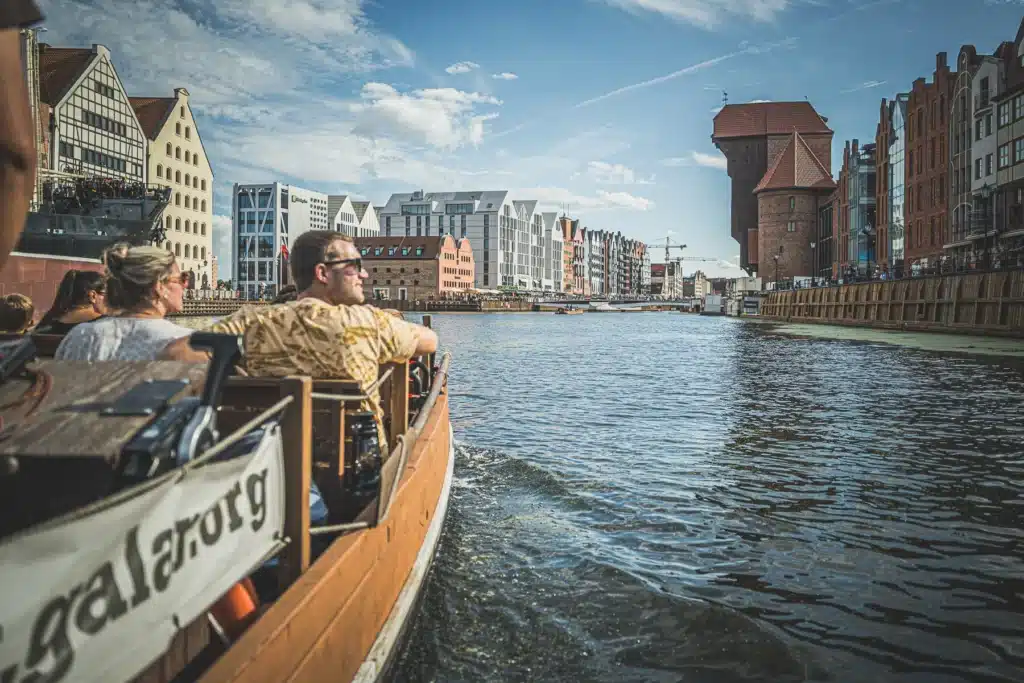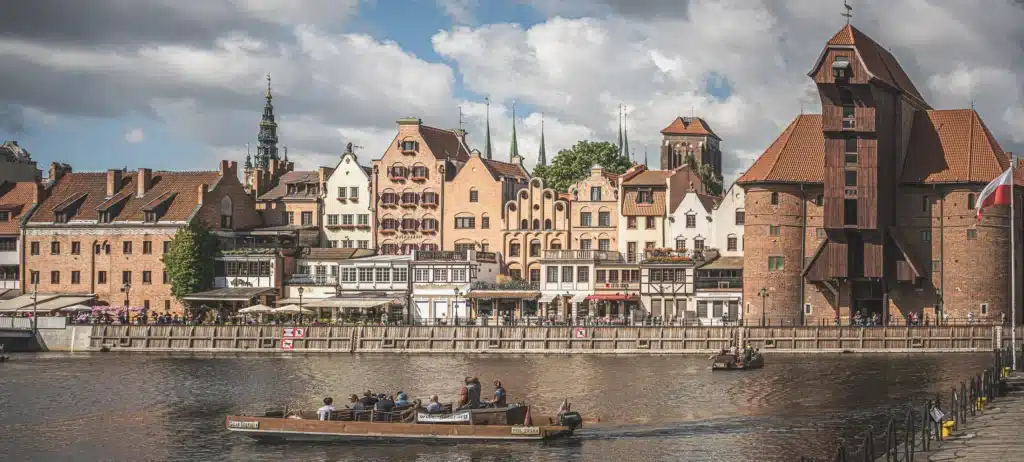



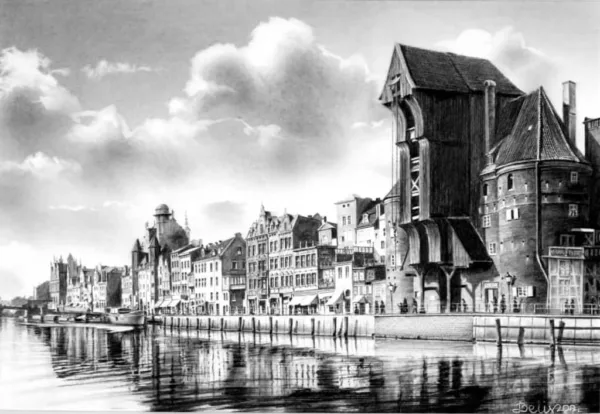
From the Motława River, its protruding wooden section is particularly visible. Further back stand two massive brick towers, with a passageway leading down to Szeroka Street beneath them. The Gdańsk Crane combined functions that we now usually entrust to separate structures: it moved cargo, opened the way into the city and helped to defend it.
A crane stood here before the present-day Gdańsk Crane
The oldest surviving reference to a crane at this site dates from 1367. The first structure was made of wood and burnt down in 1442. The new Crane was built between 1442 and 1444, already utilising a combination of brick towers with a wooden section housing the hoisting mechanisms.
The construction of this strong defensive structure met with opposition from the Teutonic Knights, whose castle was situated nearby. For the townspeople, the port facility was of economic importance, but its massive walls also provided a means of controlling access to the town from the water.
A gate capable of defending itself
The thickness of the walls and the arrowslits are a reminder of its defensive purpose. The ground storeys of the towers were particularly massive. A passageway led from Szeroka Street to the quayside, meaning the building formed part of Gdańsk’s system of water gates.
Its design was also dictated by the requirements of the crane. The mechanism had to extend above the water so that the rope could be lowered towards vessels at the quay. The wooden casing protected the mechanism, whilst the brick sections provided structural support. Viewed from the river, this division of functions is clearly visible.
How did people lift multi-tonne loads?
The drive was provided by treadwheels. Workers would climb inside them and, by treading, set them in motion. The rotation was transmitted to a shaft onto which the rope was wound. In this way, the weight suspended at its end was lifted above the deck or the quay.
The mechanism comprised two pairs of large wheels. According to the description by the National Maritime Museum, the strength of four men was sufficient to lift a load of up to two tonnes. This is an example of the application of simple principles of mechanics on a scale adapted to the needs of a large port.
Co-operation was just as important as strength. The movement of the wheel, the guiding of the rope and the positioning of the load all had to be controlled. A crane master oversaw the town’s crane. Without people capable of operating the mechanism, the building itself would not have been able to fulfil its most important function.
Transhipment, masts and repairs
The crane was used for handling cargo and erecting masts. It was particularly important during the heyday of Gdańsk’s trade at the turn of the 16th and 17th centuries. Goods arrived in the city by river and sea, and the quays required equipment to facilitate their movement.
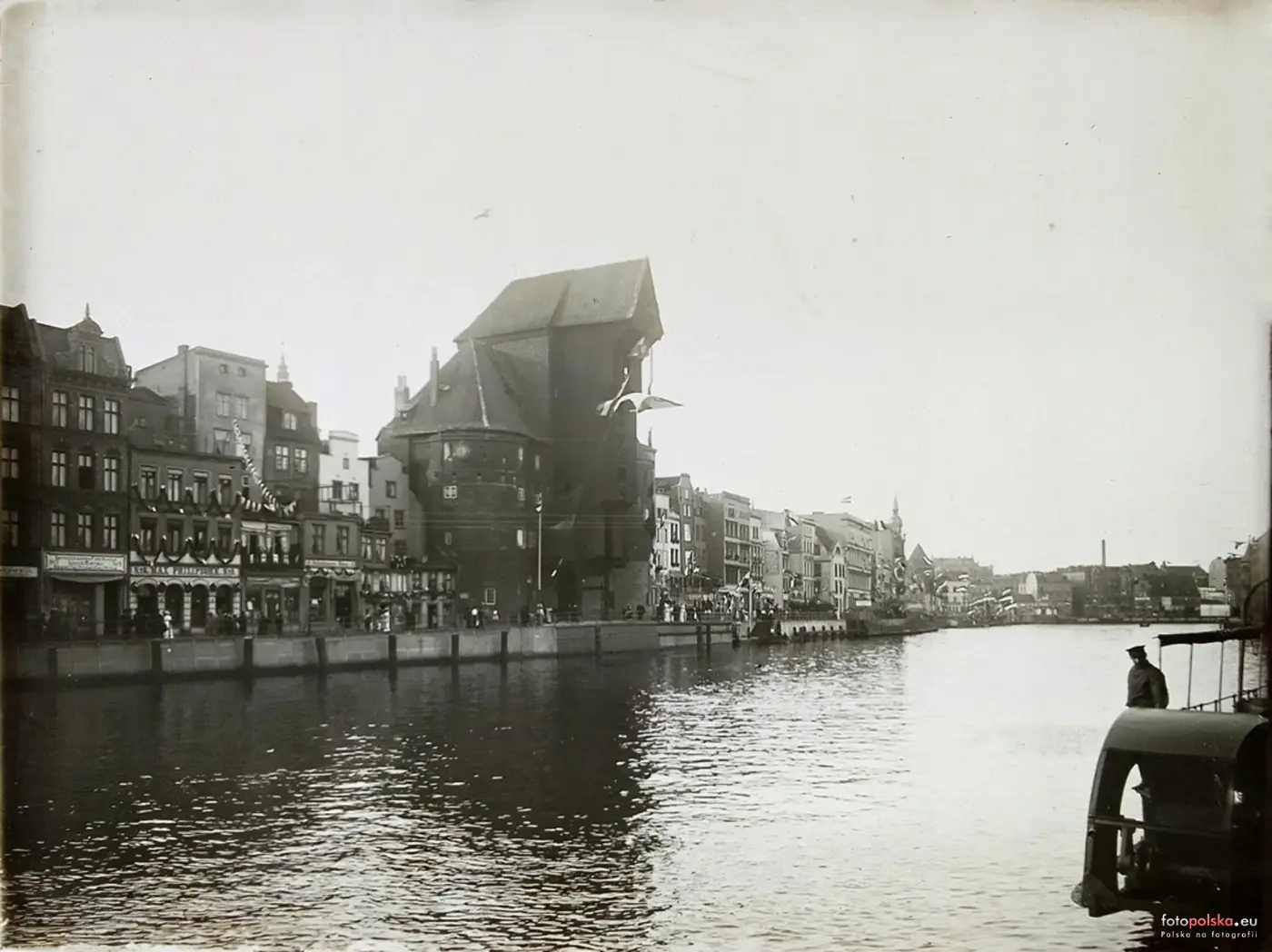
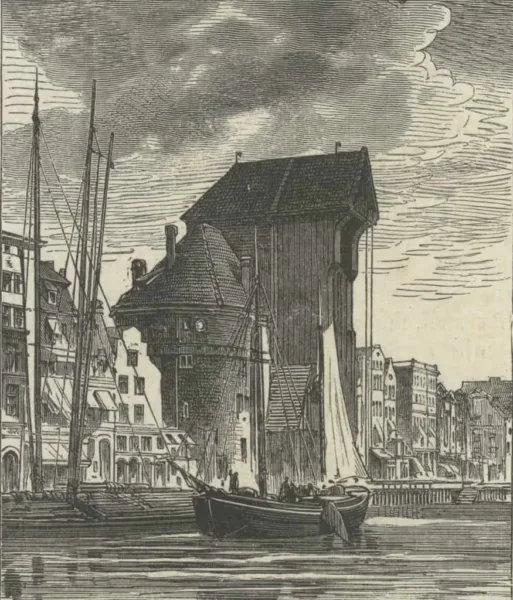
In the 19th century, the importance of the old crane declined. It was still used for work on river vessels, and later also for lifting sterns during repairs to rudders and propellers. Flats and workshops appeared in the towers. The monument, which we now associate with a museum, was also for a long time a place of everyday life.
Destruction and return to the city skyline
In 1945, the wooden part of the Crane was burnt down, and the brick towers were seriously damaged. Reconstruction began after the war. The structure was rebuilt using old illustrations and historical documentation to restore its characteristic silhouette.
The reconstructed Crane was handed over to the Maritime Museum in 1962. It retained its place in the harbour’s skyline, but was given a new role: to illustrate the history of shipping and technology. The crane’s mechanism allows visitors to combine the external view with an exploration of what really went on behind the wooden casing.
During a cruise, it is worth looking at the Crane as a former workplace. The cargo, the rope, the wheels and the people all formed a single system. Only then does this well-known symbol of Gdańsk become more than just a distinctive shape overlooking the Motława.